
Radar
Freelancing instead of two full-time jobs: better income options than overemployment in 2026
Compare freelance projects, fractional work, and a second full-time job. Includes a historical November 2025–February 2026 U.S. data snapshot and practical tradeoffs.
A second income stream can mean a disclosed part-time job, freelance clients, or two overlapping full-time roles. Those arrangements have different costs and obligations. This guide compares the choices and shows how to test a small freelance offer before relying on it for income.
The labor-market snapshot below covers November 2025 through February 2026, not today's employment figures. It provides context, not evidence that a particular worker is hiding a job or that freelancing will replace a salary. The practical comparison is about scope, time, sales, and risk.
Disclaimer: Educational information, not legal, tax, or financial advice. Before taking outside work, review your employment agreement, disclosure requirements, confidentiality and intellectual-property obligations, and local rules. Get qualified advice for your specific arrangement.
Quick summary
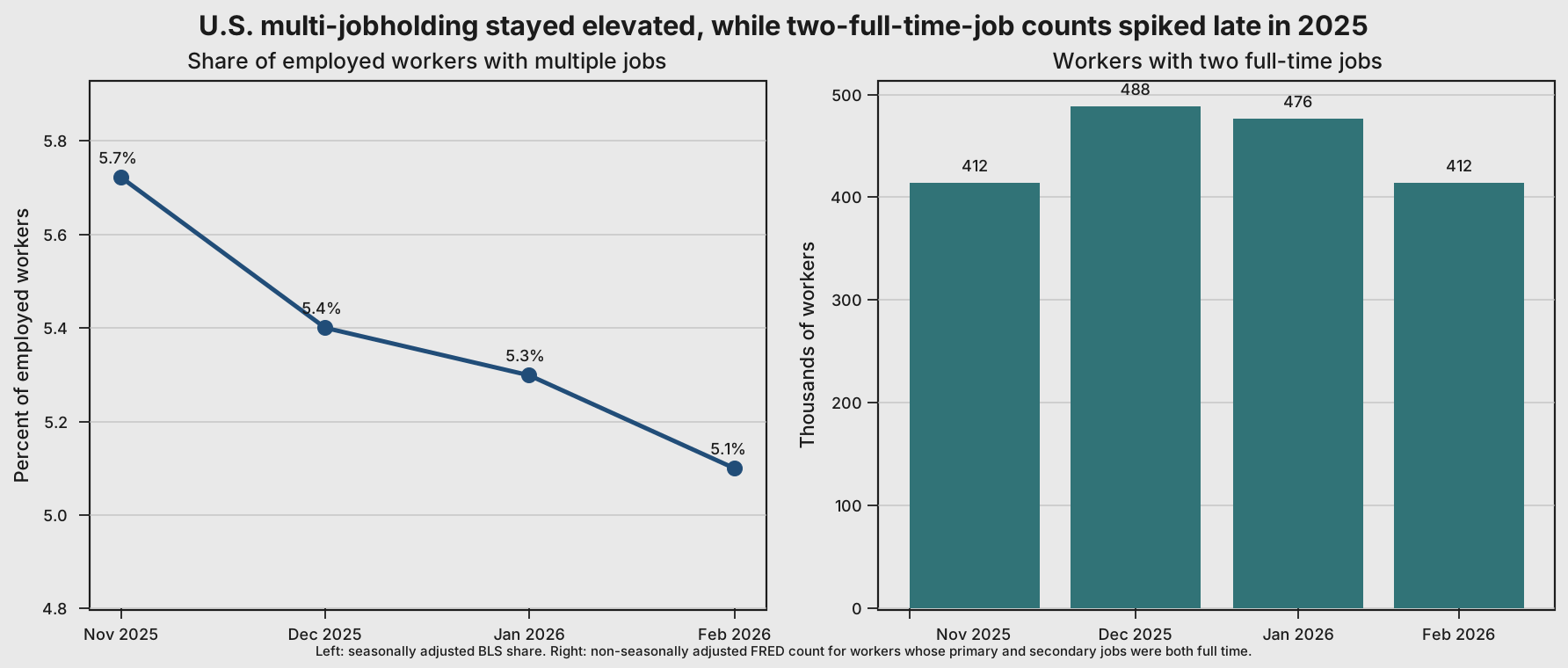
Multiple-jobholding stayed elevated in the U.S. through early 2026, and workers with two full-time jobs spiked late in 2025 before easing in February 2026. That does not mean every multiple jobholder is a secret overemployed worker. These figures describe work arrangements; they do not establish why people chose them.
For many knowledge workers, the cleaner response is not a second covert employer. It is a narrow freelance offer, a fractional role, or a productized service that can later compound into templates, workshops, or small tools. If you need the evergreen playbooks behind that transition, the most relevant internal pages are Freelancing basics, Find clients without a huge audience, Set freelance rates, and Boundaries and burnout basics.
Who this affects
- U.S.-based workers tempted by a second hidden full-time job.
- Freelancers and employees exploring fractional or portfolio work.
- People trying to trade schedule tricks for cleaner income architecture.
What to do this week
- Pick one narrow offer that solves a visible business problem in 1-2 weeks.
- Decide which layer you are building first: sprint work, retainer work, fractional work, or an asset seeded by client work.
- Install the boring basics early: pricing floor, SOW template, invoice flow, tax reserves, and a work-in-progress cap.
Evidence ladder
| Level | What it means here |
|---|---|
| Verified facts | BLS and FRED data show elevated multi-jobholding into early 2026, with workers holding two full-time jobs reaching 488,000 in December 2025 before easing to 412,000 in February 2026. |
| What the data cannot tell us | Job counts do not reveal why people take extra work, whether employers know, or whether hours overlap. Motives and disclosure cannot be inferred from these totals. |
| Informed inference | For many knowledge workers, a freelance portfolio is a cleaner substitute for a second hidden employer because it sells outcomes directly and avoids overlapping-hours problems. |
| Speculation to treat cautiously | Not every worker can replace a second salary with freelance or passive income. The path depends on skill rarity, proof of work, sales ability, and runway. |
Key definitions
| Term | Definition |
|---|---|
| Multiple jobholder | A worker with more than one job. This includes many normal arrangements, such as one full-time role plus part-time work. |
| Overemployment | A narrower and usually undisclosed version of job stacking: holding overlapping full-time jobs at the same time. |
| Polyworking or portfolio career | Openly combining several income streams, gigs, business lines, or part-time roles. |
| Freelancing | Selling defined services or deliverables to one or more clients, usually under a contract tied to scope, milestones, or a retainer. |
| Passive income | Usually semi-passive in practice: money from assets built earlier, such as templates, tools, courses, or affiliate libraries, with updates and support still required. |
Compare the work you are committing to
Start with the hours and responsibilities already promised to your employer. Then compare the extra work against that capacity. A freelance project can specify a deliverable and delivery window; a second job may require attendance at fixed times. Neither removes your existing obligations, and a client can still create schedule conflicts.
Before accepting an engagement, write down its expected delivery hours, meetings, response times, sales effort, and administration. Compare the net return after costs with the recovery time you would give up. A small trial project can test those assumptions before a recurring commitment.
What the November 2025–February 2026 data shows
| Signal | Historical reading | Source note |
|---|---|---|
| U.S. workers with multiple jobs | 9.292 million in November 2025, then 8.371 million in February 2026 | Seasonally adjusted. Source: BLS Table A-9. |
| Share of employed workers with multiple jobs | 5.7% in November 2025, 5.1% in February 2026 | Seasonally adjusted. Source: BLS Table A-9. |
| Workers with two full-time jobs | 488,000 in December 2025; 476,000 in January 2026; 412,000 in February 2026 | Not seasonally adjusted. Source: FRED LNU02026631. |
| Important interpretation point | Not every multiple jobholder is secretively overemployed | The government category also includes normal and disclosed combinations of work. |
The first category mistake to avoid is treating every multiple jobholder as a secret overemployed worker. BLS uses a broad category. A multiple jobholder might have one main job and one weekend shift, one main job and a seasonal side gig, or one main job and a freelance client. The category is broader than the meme.
BLS Table A-9 in the March 6, 2026 release reports 9.292 million U.S. multiple jobholders in November 2025, representing 5.7% of employed workers on a seasonally adjusted basis. By February 2026 that figure eased to 8.371 million, or 5.1%, but it remained elevated. The more specific FRED series for workers whose primary and secondary jobs were both full time reached 488,000 in December 2025, then 476,000 in January 2026 and 412,000 in February 2026.
These numbers are a historical snapshot from the BLS releases linked below. The overall multiple-jobholding series is seasonally adjusted; the two-full-time-jobs series is not. BLS updates population controls and can revise estimates, so use the cited release when comparing this table with a later data download.
Start with your reason for seeking extra income
The job counts do not establish workers' motives. Your own reason still matters: covering an immediate shortfall, reducing reliance on one employer, testing a business, or building a reusable product each calls for a different approach. Separate the amount you need from the time and money you can risk.
- For an immediate shortfall, compare the time to an actual payment and the certainty of that payment.
- For a business experiment, cap the trial's hours and expenses before you start.
- For longer-term independence, test repeat demand before treating projected revenue as dependable income.
Why secretly holding two full-time jobs is usually brittle
Hidden dual full-time employment can produce short-term cash, but it is often structurally fragile. It depends on low meeting load, weak oversight, flexible calendars, and luck. Calendar blocking, separate devices, and carefully chosen roles are not a moat. They are coping mechanisms for a schedule conflict that never stops existing.
There is also the contract layer. Whether outside work is permitted depends on your obligations and the applicable rules. Employment agreements may contain exclusivity language, conflict-of-interest rules, confidentiality obligations, moonlighting policies, or time-reporting requirements. The risk is often simpler than a dramatic legal story: breach of contract, termination, or professional damage if the arrangement becomes visible.
Then there is burnout. The guide to boundaries and burnout basics is useful here because it frames exhaustion as a systems problem, not a personal virtue contest. Two hidden full-time roles create a system with relentless context switching, weak recovery time, and no honest capacity planning.
Most important, covert overemployment does not compound especially well. You can get a second salary, but you do not automatically build a client base, a reusable offer, a public body of proof, or an asset that keeps earning later.
Qualitative comparison, not measured risk scores. Actual control, returns, and workload depend on the agreement and demand.
| Dimension | Two hidden full-time jobs | Freelancing | Asset income |
|---|---|---|---|
| Schedule control | Low. Two employers can both claim the same daytime hours. | Medium to high. You control scope, delivery windows, and client count. | High once the asset exists. |
| Contract clarity | Often weak if undisclosed. Conflict, confidentiality, and exclusivity issues can matter. | Stronger. Work is sold as a project, retainer, or fractional engagement. | Depends on platform, licensing, and tax structure. |
| Income ceiling | Limited by salary bands and manager approval. | Higher if you specialize, productize, and raise rates. | Highest upside in theory, but usually the slowest to validate. |
| Risk of sudden collapse | High if schedules collide or a policy changes. | Medium. Client concentration still matters. | High early, then lower if demand becomes durable. |
| Compounding value | Weak. More hours, more meetings. | Strong. Testimonials, referrals, and productized offers compound. | Strongest if the asset earns repeatedly. |
| Burnout pattern | Hidden overload and context switching. | Sales plus delivery stress. | Front-loaded building stress plus maintenance. |
Why freelancing is often the cleaner alternative
Freelancing is not easier than employment. What it changes is the shape of the risk. Instead of pretending two employers each deserve the same 10 a.m. slot, you sell a defined outcome to one or more clients. The contract can say exactly what is being delivered, on what timeline, and for what fee. That is cleaner economically and cleaner operationally.
Freelancing also gives you room for rate leverage. In salary work, pay is tied to bands, cycles, and approval chains. In independent work, the upside comes from specialization, packaging, and proof. A good audit, sprint, or retainer can be priced off business value rather than internal title politics. If you need the evergreen mechanics, the best starting links are Set freelance rates and the Rate Calculator.
A freelance model compounds in ways dual employment usually does not. Every successful project can become a testimonial, referral source, case study, template, or standard operating procedure. A well-designed offer can become productized. A client need you solve repeatedly can turn into a course, toolkit, template pack, or micro-SaaS. That is the bridge to semi-passive income.
There are tradeoffs. The IRS reminds self-employed workers that they usually need to pay estimated taxes quarterly and handle self-employment tax as well as income tax. You also have to manage health insurance, invoicing, bookkeeping, and uneven cashflow. But if your actual goal is control plus upside, freelancing usually points in the correct direction.
The best freelance options for people tempted by overemployment
The best freelance options are usually the boring ones. Boring is beautiful because businesses buy boring things quickly when the pain is obvious. Think reporting cleanups, bookkeeping, analytics fixes, paid media maintenance, recruiting support, documentation sprints, automation reviews, design teardowns, and code audits. These are easy to explain, easy to scope, and easy to connect to money, speed, or risk reduction.
A useful rule from Freelance Codex is to choose one narrow offer before you attempt a full freelance identity. Do not start with "I do strategy, writing, AI, growth, and product." Start with "I fix your attribution tracking in 10 days" or "I turn your chaotic onboarding into a documented process in two weeks." Clients buy fewer nouns and more relief.
Relative speed labels are planning judgments, not earnings or time-to-client guarantees.
| Model | Use case | Relative speed | Potential fit |
|---|---|---|---|
| Agency subcontracting or white-label work | A possible route to first revenue when you already have a relevant skill and an agency contact. | Fast | Designers, marketers, writers, developers, ops specialists |
| Fixed-price audit or sprint | A one- to two-week outcome such as an SEO audit, analytics cleanup, automation review, code audit, or messaging reset. | Fast | Knowledge workers who can define a clear before-and-after |
| Monthly retainer | A recurring service with a clear cadence, such as bookkeeping, reporting, email ops, paid search management, or client support. | Medium | Workers who want predictable monthly income |
| Fractional specialist role | A limited-scope recurring seat, such as fractional RevOps, FP&A, content lead, recruiting ops, or engineering ops. | Medium | Experienced workers with credibility |
| Productized asynchronous service | A tightly defined package with a standard process, timeline, and output. | Medium | People who want repeatability and easier delegation |
| Marketplace bridge work | Useful for quick cash and proof, but better as a bridge than a forever strategy. | Fast | People who need immediate deal flow while building direct channels |
How to match your current job to a freelance lane and an asset lane
One reason people freeze is that they imagine freelancing as a total reinvention. It usually is not. The first freelance offer should often be a stripped-down version of a problem you already solve at work. The trick is to separate the valuable outcome from the internal company context around it.
A finance operator does not need to become a generic consultant overnight. They can sell a forecasting model cleanup, KPI dashboard reset, or monthly close process redesign. A marketer can sell an analytics audit or email automation cleanup. A software engineer can sell a code review sprint, QA automation setup, or cloud cost review. Once the service side works, the asset side becomes visible: calculators, templates, playbooks, small tools, recorded workshops, or a niche newsletter.
One possible sequence is services first, recurring work once demand is established, and reusable products later. You do not need all three layers. Each additional offer creates sales, delivery, and support obligations; choose the smallest combination you can run reliably.
| Current skill base | Freelance offer | Semi-passive asset |
|---|---|---|
| Software and IT | Code review sprint, QA audit, automation setup, cloud cost review, DevOps cleanup, security awareness training, fractional engineering ops | Micro-SaaS, template packs, technical courses, licensing internal tools |
| Marketing and growth | Email funnel build, analytics audit, paid media cleanup, SEO content plan, conversion review, marketing ops retainer | Recorded workshops, swipe files, niche newsletter, affiliate content |
| Finance and operations | Bookkeeping cleanup, forecasting model, KPI dashboard, SOP buildout, vendor process redesign, fractional FP&A | Templates, calculators, dashboard kits, paid playbooks |
| Design and product | Figma teardown, design system cleanup, landing page sprint, UX audit, product discovery facilitation | Template libraries, icon packs, mini-courses, premium component kits |
| People, recruiting, and training | Interview process audit, onboarding redesign, recruiter sourcing sprint, manager training workshop | Playbooks, workshop recordings, assessment templates |
| Writing and education | Case study package, documentation sprint, technical writing cleanup, curriculum design, ghostwriting system | Courses, prompt libraries, guides, subscription archives |
How to get freelance clients without becoming a content machine
The fastest path to client revenue is usually not a giant audience. It is proximity. Freelance Codex explicitly recommends starting with former coworkers, managers, vendors, agencies, and adjacent freelancers. That advice is grounded in reality. If people already know how you work, the sales conversation is shorter and the trust hurdle is lower.
Agency overflow is especially underrated. If you have a real skill and not just a vague ambition, agencies can feed you white-label work while you build proof and direct relationships. Marketplaces can also help, but they are best treated as a bridge, not a religion.
Warm outbound also works when the offer is narrow. A short message saying "I noticed your paid search landing pages do not track key conversions; I fix that in one week" is a very different creature from "Hi, I am available for freelance marketing help." One is a business intervention. The other is a resume whisper. If you need the underlying system, start with Find clients without a huge audience.
The channel comparison is illustrative. MBO's platform-use statistic concerns its surveyed U.S. independent service providers; it is not a success rate.
| Channel | Relative speed | Potential lead quality | Notes |
|---|---|---|---|
| Former coworkers, managers, and vendors | Fastest | High if trust already exists | Usually the cleanest first lane for a new freelancer. |
| Agency overflow and white-label benches | Fast | Medium | Strong bridge model if you want revenue without heavy personal branding. |
| Marketplaces and talent platforms | Fast to medium | Variable | Useful as a cashflow bridge. MBO reports that 63% of independent service providers used online talent platforms in 2025. |
| Warm outbound to niche firms | Medium | High | Works best with a very narrow offer tied to money, speed, or risk reduction. |
| Referral loops with adjacent specialists | Medium | High | Build relationships with people who touch the same client but solve a different problem. |
| Workshops, webinars, and audits | Medium | High | Teach first, then convert the most urgent buyers into projects or retainers. |
A practical 30-day shift from needing another salary to building a freelance income stack
Week 1 is about subtraction. Pick one narrow offer, one target buyer, and one minimum acceptable rate. You do not need a full website. You need one sentence that states the pain, the outcome, the timeline, and the price range.
Week 2 is about proof and reach. Build one short offer page or PDF, gather two or three examples of work you have permission to share, and make a warm list of 25 people or firms who already touch your domain. Then contact them directly. Ask for a small project, not a life commitment.
Week 3 is about selling a sprint. The first deal should usually be time-boxed: an audit, cleanup, workshop, teardown, or build sprint. That can create revenue and a clearer view of what the client really values.
Week 4 is about installing boring business plumbing: a statement of work, invoice flow, bookkeeping system, tax savings rule, and boundaries. Open a separate business account if you can. Route a percentage of every payment into tax reserves. Decide your maximum work in progress before demand forces the decision for you.
For a step-by-step version of that transition plan, start with Leaving your job to freelance and the First 30 Days Checklist.
- Pick one narrow offer, one buyer, and one minimum acceptable rate.
- Build a one-page offer and gather proof from past work.
- Sell a paid sprint first, then expand only if the need is real.
- Install invoicing, bookkeeping, tax reserves, and work-in-progress limits.
Passive income, honestly described
This is the part of the internet where the fog machine gets turned on. In freelance circles, "passive income" usually means semi-passive income. A template bundle, course, toolkit, newsletter archive, or micro-SaaS may eventually earn without a fresh sales call every time, but it is rarely born passive. It is designed, tested, revised, distributed, supported, and updated by a human who is very much awake.
Asset income still matters because it changes the economics of freelancing. The best assets usually come from service work first. You notice the same problem five times, build a repeatable solution, document it, and then package it. That is much more credible than deciding on Tuesday that you will create a course because the internet told you so.
A good rule is to build passive layers in order of validation. First sell the work manually. Then templatize part of it. Then teach or productize it. Then, only if there is durable demand, consider a more technical asset such as software.
| Asset type | Setup effort | True passivity | Notes |
|---|---|---|---|
| Template bundle | Medium | Low to medium | Best when you already have a proven process and know exactly what buyers repeat. |
| Recorded workshop or course | High | Low at first | Works better after live workshops validate the material. |
| Newsletter archive, paid report, or small membership | High | Low at first | Needs niche credibility and distribution. Can compound well if the topic changes over time. |
| Micro-SaaS or small tool | Very high | Medium once stable | Potentially excellent economics, but also the highest technical and support burden. |
| Affiliate library tied to real use | Medium | Medium | Only durable when it rides on trust, search traffic, or an existing audience. |
| Licensing internal tools or SOPs | Medium to high | Medium | Good for specialists who have already built repeatable internal assets. |
An illustrative income stack that can replace the logic of a second job
This example is not a promise. It is a simple model showing how a freelance stack can replace the logic of a second full-time job without requiring two employers to believe they each own your weekdays. The totals below are gross revenue, not take-home pay. Taxes, software, benefits, and occasional dry spells are real. The structure is the point: one recurring layer, one project layer, one anchor client, and one asset layer.
| Income layer | Illustrative monthly gross | Why it exists |
|---|---|---|
| 2 retainers at $1,500 each | $3,000 | Recurring monthly gross revenue from narrow, repeatable work |
| 1 audit or sprint per month at $2,500 | $2,500 | A higher-margin project that creates case studies and referrals |
| 1 fractional half-day-per-week engagement | $2,000 | A stable anchor client without a full second employer |
| Templates, affiliate content, or a mini-course | $800 | Semi-passive layer that compounds over time |
| Total gross monthly revenue | $8,300 | Before taxes, software, health insurance, and other business costs |
The hard parts freelancing does not remove
Freelancing can be a better alternative to two full-time jobs, but only if you respect its costs. You still need health insurance, retirement planning, bookkeeping, tax discipline, and a tolerance for sales. You also need the emotional discipline not to say yes to every client because cashflow is lumpy.
Client concentration is a silent hazard. Three clients who each represent a third of your revenue can feel diversified compared with one employer, but that is still fragile if one account disappears. The fix is ongoing business development, careful scope control, and a runway buffer.
There is also a skill question. The easiest freelance work to sell is work that creates clear value and does not need enormous supervision. Not every employee role translates instantly into that form. Some workers will need a bridge period: a platform, a subcontractor arrangement, a certification, a portfolio refresh, or a smaller first offer.
The final realism check is that passive income does not absolve you from audience, distribution, or trust. Even a beautiful toolkit needs buyers. Even a small software product needs support. The dream is not to escape work entirely. The dream is to build an income mix in which more of your effort becomes reusable over time.
FAQ
Is it legal to work two full-time jobs in the U.S.?
Whether an arrangement is permitted depends on the applicable rules and your obligations. Employment contracts, exclusivity clauses, conflicts of interest, confidentiality rules, time-reporting obligations, and use of employer equipment can all matter. The legal question is often less dramatic than the contract and policy question.
Can freelancing really replace a second salary?
Sometimes, yes, especially for knowledge workers who already know how to create clear business outcomes. The most reliable path is usually not random gig work. It is a narrow offer with obvious value, sold repeatedly, then expanded into recurring retainers or fractional work. The tradeoff is that you must sell, invoice, and handle taxes yourself.
What freelance services tend to sell fastest?
Services with a clear, bounded deliverable include audits, cleanups, reporting, automation, bookkeeping, recruiting support, paid media maintenance, analytics setup, documentation, and white-label production for agencies. Businesses buy these because the value is visible and the scope is easier to define.
Is passive income actually passive?
Usually not. Most so-called passive income for freelancers is semi-passive income. A template, course, toolkit, newsletter archive, or micro-SaaS may eventually require fewer hours than service work, but it still needs updates, distribution, customer support, and sometimes sales conversations. The initial build phase is very active.
Final takeaway
Choose one income experiment you can run openly within your existing obligations. Set a limit on its hours and costs, write down the result you need, and test demand before replacing dependable income. Use the rate calculator to model billable capacity and the statement of work template to make a first project's boundaries explicit.
Selected sources
- BLS Employment Situation, March 6, 2026: Tables A-9 and A-16 (February data)
- BLS Employment Situation, January 9, 2026: Table A-16 (December data)
- BLS Employment Situation, February 11, 2026: Table A-16 (January data)
- FRED: workers whose primary and secondary jobs are both full time
- MBO Partners: 2025 survey of online talent platform use
- IRS Self-Employed Individuals Tax Center
- IRS Estimated Taxes
Loading comments…
Comments
Sign in to comment.